
Hastings City Directory Holdings
The verified Hastings city directory resource is a telephone-directory collection, not a proven complete run of Polk volumes or reverse books. The Minnesota Historical Society finding aid lists a 1928 Hastings print directory, followed by selected print, yellow-page, and fiche holdings through 2010. White pages can tie a subscriber or business name to an address and telephone number at a moment in time. Yellow pages sort businesses by subject, so they answer a different question.
Use the table as a shelf map. It identifies what has been verified, where to start, and where the format changes. It does not convert a telephone listing into proof of residence, ownership, or continuous occupancy.
| Verified Hastings collection | Years held | Custody | How to consult |
|---|---|---|---|
| Telephone directory, shelf 1602 | 1928 | Minnesota Historical Society | Finding-aid shelf reference |
| Print telephone volumes | 1953-1968 | Minnesota Historical Society, shelves 1603-1616 | In-library print volumes |
| Print, duplicate, and yellow-page volumes | 1970-1986 | Minnesota Historical Society, shelves 1617-1631 | In-library shelf holdings |
| Print, yellow-page, and fiche holdings | 1987-1995 | Minnesota Historical Society, shelves 2963-2973 and fiche 660-838 | Fiche requires library equipment |
| Later print, yellow-page, and fiche holdings | 1996-2004 | Minnesota Historical Society, shelves 3618-3745 | In-library shelf holdings |
| Later telephone volumes | 2007-2010 | Minnesota Historical Society | Listed print and yellow-page holdings |
The MNHS telephone-directory finding aid lays out the shelf and year inventory for this Hastings city directory search.
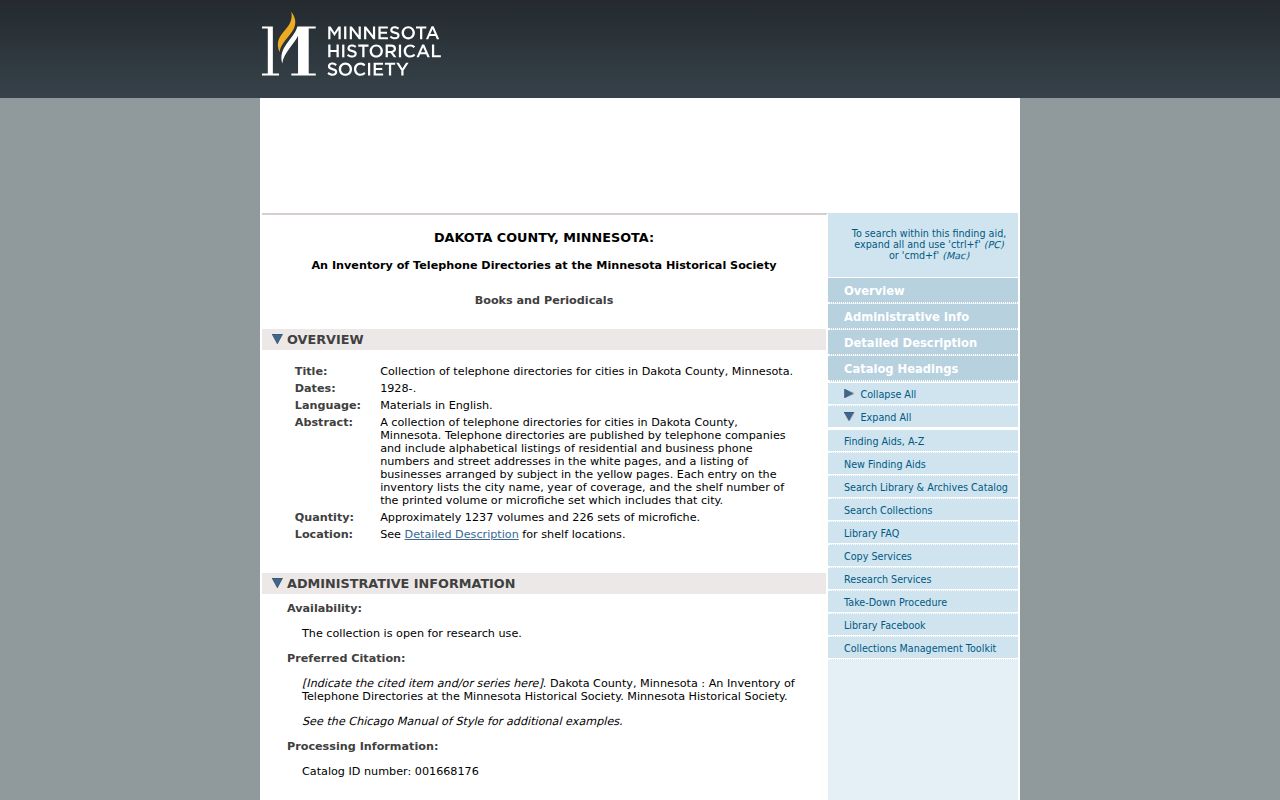
Use the inventory to request a specific volume or fiche range. Note whether each item is white pages or yellow pages. Note whether it is print or fiche. The listed inventory skips several stretches. These include 1929-1947, 1949-1952, 1969, 1993, and 2005-2006. Keep a blank year a blank year in your notes. A gap in the collection is not evidence that a household left Hastings.
Hastings City Directory Years
These directories earn their value as a sequence. The 1928 volume marks the earliest verified telephone-directory point for Hastings. The fuller postwar and later holdings let you compare a surname and initials across many dated volumes. You can also compare address spellings and phone numbers. Duplicate copies and yellow-page companions are holdings quirks, not separate editions. Record the exact shelf, fiche number, and page before moving on.
| 1928 | Earliest listed Hastings telephone directory, shelf 1602. |
|---|---|
| 1948 | Postwar directory holding on shelf 1397. |
| 1953-1968 | Annual or near-annual continuity is possible where a listed volume exists. |
| 1987-1995 | Mixed print and fiche formats require noting the format used. |
| 2007-2010 | Last listed Hastings telephone volumes in the finding aid. |
One limitation shapes the directory history here. No official source pinpoints a first or last Polk-style Hastings city directory, a publisher history, or a verified reverse-directory run. Ask the custodian about the specific volume you need. Assume nothing about an address-order section existing. Note: A missing directory year is an access gap, not a reliable statement about a person or household.
Hastings City Directory Archives
Several custodians hold parts of the Hastings historical record. The Minnesota Historical Society Library in St. Paul has maps, newspapers, railroad records, state archives, court and probate material, municipal records, school censuses, vital material, tax lists, and walk-in research databases. Its public hours are Tuesday 9:00-8:00 and Wednesday through Saturday 9:00-4:00. Call 651-259-3300 or write reference@mnhs.org before a focused visit.
The Dakota County Historical Society Research Library adds city directories, county newspaper microfilm, clipping files, more than 10,000 photographs, family tools, and some Hastings Sanborn maps from the 1920s. Its Lawshe Memorial Museum and Research Library is in South St. Paul, with research hours listed as Wednesday and Friday 9:00-5:00, Thursday 9:00-8:00, and Saturday 10:00-3:00. The City Hall Pioneer Room is another Hastings-specific lead for records about the town and its citizens, but no online catalog or search inventory was verified.
The MNHS Library collection page introduces the library's local-history and archive materials.
Library holdings supply the map, newspaper, tax, court, or census layer a telephone entry cannot. Bring your copied directory detail along rather than trusting memory.
Hastings Directory Newspaper Clues
Newspaper titles work as search keys in Hastings. The Dakota Weekly Journal began on May 24, 1856. The county seat moved to Hastings on June 2, 1857. The Minnesota Conserver started in Hastings in 1861. It became the Hastings Conserver in 1863. It merged with the Hastings Independent into the Hastings Gazette in 1866. Later catalog records place the Hastings Herald at 1925-1937 and the Hastings Star at 1977-1980. When a name surfaces in a Hastings city directory, search the title that matches the year. Use DCHS clipping files and newspaper microfilm. An announcement can reveal a relative, a church, a business, or a move. Treat each item as a dated lead. Then compare it with a vital index, a probate record, or a county instrument whenever the question demands proof.
Read a Hastings City Directory Listing
The 1945 Central Telephone Directory is an alphabetical listing. It has residential and business sections plus service information. Its entry fields are simple: a subscriber or business name, a street address, and a telephone number. The volume itself warns that errors and omissions can remain. So read each entry as a strong dated pointer. It is not a census, deed, voter record, or statement of who owned a property.
| Subscriber or business name | Identifies the listing as printed, including initials or a business style where used. |
|---|---|
| Street address | Supplies the listed location for that edition; preserve abbreviations and numbering exactly. |
| Telephone number | Connects the subscriber to the service listing for that dated volume. |
| Section | Distinguishes an alphabetical residential or business listing from other material in the book. |
| Reliability warning | The 1945 directory cautions that errors and omissions may remain. |
- Criss-cross directory
- An address-order directory, used to find listings by street and number. A verified Hastings reverse or criss-cross run was not located.
- Householder index
- A name index centered on a household or head of household. Check a volume's own front matter before assuming it includes one.
- Abbreviation key
- A page explaining a volume's shortened labels. Photograph or transcribe it when the particular directory provides one.
A directory hit can point toward the modern Hastings street directory once the task turns to resolving a present parcel or street. Keep historical subscriber evidence and current parcel records separate in your notes. Note: Preserve the entry spelling and edition date, because later records may use a different address form or surname style.
Hastings City Directory Map Layers
Maps turn a street address in the Hastings residents directory into real ground. The Library of Congress has digitized six Hastings Sanborn editions. They cover March 1884, May 1891, April 1898, November 1904, November 1910, and April 1911. DCHS also notes some Hastings Sanborn sheets from the 1920s. Each sheet shows a building's footprint, its use, street labels, and fire-insurance context. The maps do not list every occupant. So treat them as a companion to the directory rather than a substitute for it.
Address eras complicate things too. The old compact grid and the downtown 2nd Street core look nothing like the later Vermillion Street corridor. Nor do they match the TH 61 expansion or the curving post-1950 subdivisions. An early directory may cite a lot and block, or a township reference. A later street directory gives a numbered street instead. Before joining records across years, compare the edition date. Also compare the address style the source itself used.
Trace Hastings City Directories
Start with what you know. A name, an approximate year, and a likely Hastings street will carry a household search a long way. The aim is a dated sequence of listings, not a conclusion drawn from one entry. Pair each directory year with state and federal census material. Watch the locality label as well. Historical township and city lines rarely match a modern map of Hastings.
- Find the surname and initials in the closest verified telephone volume, then copy the address, number, page, shelf, and year.
- Check the next available listed volume forward and back. Mark every address or telephone change, plus any gap in the collection.
- Search DCHS clippings and newspaper microfilm around a move, death, marriage, business notice, property transfer, or civic event.
- Compare the date with the Minnesota state-census guide and applicable federal census material for household composition.
- Use church, cemetery, vital, will, naturalization, deed, and Sanborn records as corroboration, preserving the actual image, shelf, roll, or instrument reference.
A name can vanish from a directory for several reasons. The person moved. They may have died, changed the listing form, or fallen into a gap in the holdings. For Hastings, an obituary trail runs through DCHS clippings and newspaper microfilm. A vital index can then confirm what the newspapers suggest. No dedicated official Hastings obituary-name index exists. Plan on searching by newspaper title and date range.
Note: Record the collection title and exact page first, because an archive result is only a lead until the original record is reviewed.
Hastings Directory Custody History
Early Hastings records do not always sit under the city's name. MNHS finding aids describe Ravenna Township material spanning 1859 to 1955, including minutes from 1859 through August 1860 that are actually Hastings city records predating the June 1860 township split. The Dakota County index adds land-registration, district-court, probate, naturalization, tax, township, and municipal material. Custody follows the creating office and the historical boundary. It never follows the label a searcher would prefer.
For an early resident, search the surname alongside Ravenna, Hastings, the street or lot, and the newspaper title. That habit keeps a catalog gap from turning into a false claim that a person or record never existed at all.